
Brick House Accuracy & Gun Works
Barrel Life Estimator — Planning Record
Generated Nov 29, 2026, 5:24 AM · Current on-screen inputs and outputs
Field Tool 01
Barrel Life Estimator
Barrels don't die on a schedule — they die from throat erosion, and the biggest drivers are powder charge relative to bore size, powder heat, pressure, and how fast you shoot. This estimator returns an honest window, not a fake-precise number. Twist rate barely matters; heat does.
No saved rifle is active.
Create a rifle profile →Cartridge
Case capacity, bore area, typical match charge, and pressure are loaded automatically.
Overbore index959Moderate (800–1,000)
Load & Powder
Pressure is the throat killer. Backing off 1–1.5 grains often buys real barrel life.
Two powders at the same velocity don't erode equally. Cooler single-base powders (H4350 class) are gentler than hot double-base magnums (N560, RL-26 class).
Firing Schedule
Ten rounds in ninety seconds is not the same as ten rounds in thirty minutes. Heat soak accelerates throat wear.
Suppressors trap heat at the muzzle and raise dwell pressure — a modest penalty on bolt guns, a real one on gas guns.
Barrel & Standard
416R stainless is the precision baseline. Nitriding can extend wear life if done after final lapping.
'Dead' depends on your standard. A barrel that's done for benchrest still has years of hunting left in it.
Estimated Barrel Life
LiveMatch-grade life
2,175–3,400
rounds · confidence high
Match-grade window2,175–3,400 rds
Top-tier accuracy starts to fade: velocity drifts, groups open past your node.
Hunting-useful window3,700–5,800 rds
Still holds field accuracy for ethical shots at practical ranges.
Usable life4,800–7,500 rds
Velocity consistency, fouling, or throat condition eventually make it not worth shooting.
Base estimate (before conditions)2,596 rds
Your conditions multiplier× 1.05Your usage is gentler than baseline
Calculation DetailCalibrated planning model
The result above is rounded for readability. This panel shows the inputs, arithmetic, and assumptions used before that display rounding.
BHA barrel-life planning method
Estimated range = cartridge and bore class + selected firing conditions + BHA-calibrated wear model + uncertainty band
Your values and constants
Selected cartridge
6.5 Creedmoor
Overbore index shown above: 959
Load and powder
Book-max load; cooler single-base powder class
Firing conditions
normal cadence; unsuppressed; 416R stainless
Accuracy standard
Match / PRS
Substitution and intermediate steps
Baseline assessment
BHA compares the cartridge’s thermal demand and bore relationship against its protected benchmark and wear-model library.
Condition adjustment
Your selected load intensity, powder class, cadence, suppressor use, and barrel treatment move the baseline toward a gentler or harsher use case.
Displayed match window
2,175–3,400 rounds, rounded to practical 25-round bands
Displayed hunting window
3,700–5,800 rounds, using the selected accuracy standard
Assumptions and limits
- This is a BHA calibrated planning model, not a physical throat-erosion simulation or a barrel-life guarantee.
- Benchrest and hunting windows are display standards derived from the same match midpoint. Real barrel condition is confirmed by bore inspection, chronograph data, and group history.
Data lineage
BHA’s cartridge classification, calibration coefficients, and benchmark observations remain internal. This panel discloses the selected scenario, result band, and decision path without publishing the complete model recipe.
This is an estimator, not a warranty. Real barrel life is confirmed with a borescope, chronograph data, and group history — which is exactly what a BHA documented test package tracks for every rifle we build or tune.
Opens your browser’s print dialog. Choose Save as PDF to keep this current planning record.
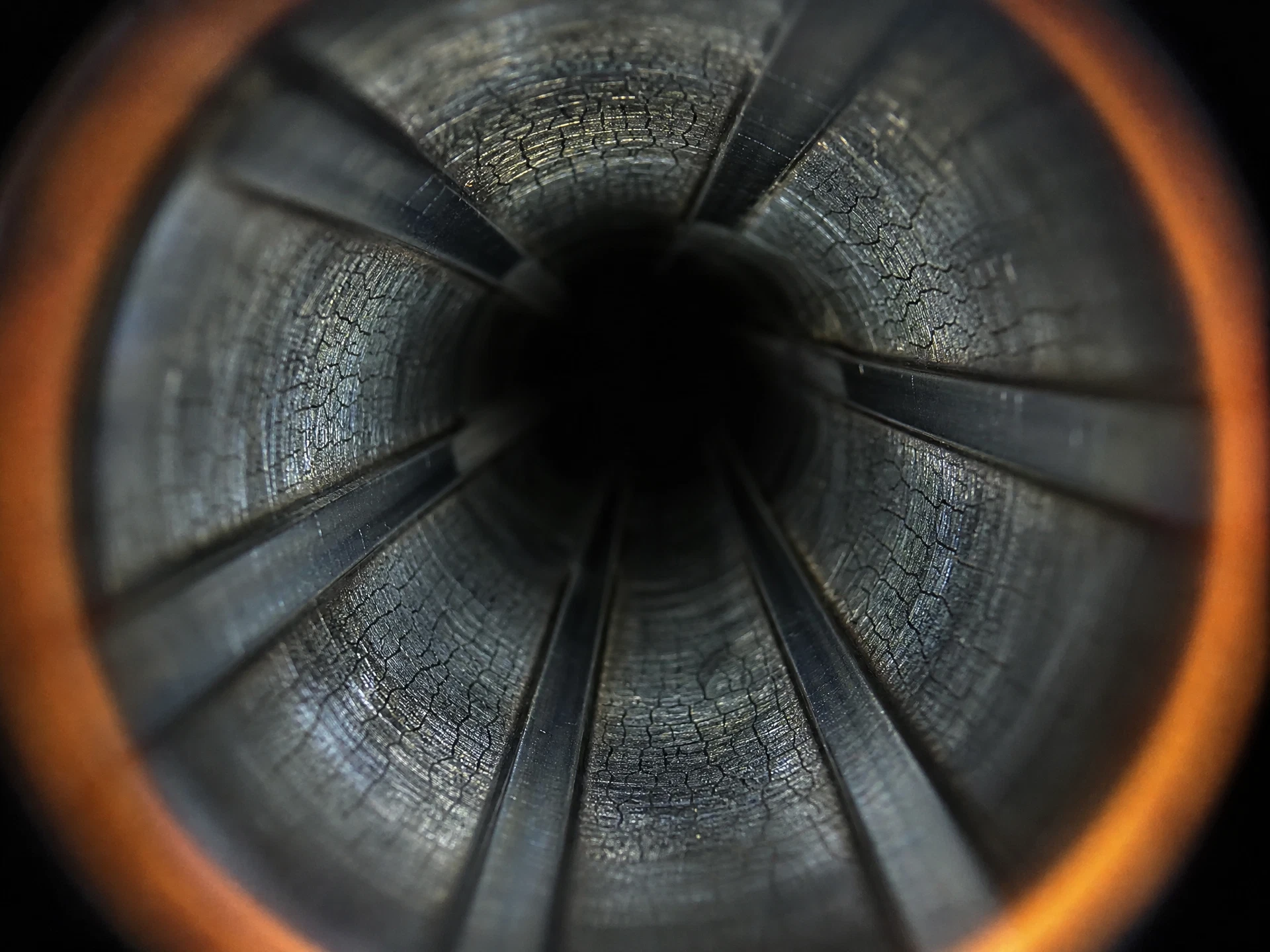
Fire-cracking at the throat — the alligator-skin pattern that actually kills precision barrels. Heat, not bullet friction, does the damage.
How this estimator works
Why we show a range, not a number
Barrels wear out at the throat — the first inch of rifling ahead of the chamber — where propellant gas at several thousand degrees scours the steel on every shot. The single best predictor of how fast that happens is the overbore ratio: how many grains of powder you burn relative to the cross-section of the bore. Seventy grains behind a .284 bore is a far harsher life than forty-four grains behind a .308.
Our model starts from that charge-to-bore relationship, adjusted for chamber pressure and calibrated against real-world barrel life reported across thousands of match and hunting barrels. Then your conditions — load intensity, powder class, firing cadence, suppressor use, and barrel steel — scale the estimate up or down. Twist rate gets no input field on purpose: compared with the thermal punishment from powder gas, its effect on barrel life is a rounding error.
Any tool that hands you "1,437 rounds" is dressing up a guess. The honest answer is a window, and the window moves with how you shoot. When the estimate matters — a competition season, a once-in-a-lifetime hunt — the throat should be verified with a borescope and a chronograph, not a calculator.
The Brick House difference
Every rifle we build or tune leaves with a documented test book: velocity averages, SD/ES, group history, and throat condition. Log that data every 100–200 rounds and the guesswork disappears — you'll know how much match-grade life your barrel actually has left, not what a formula predicts. See how our documented testing works →
Brick House Accuracy & Gun Works
Barrel Life Estimate
A rounded planning window for the selected chambering, use pattern, and accuracy standard.
Match-grade life2,175–3,400 rdshigh confidence
6.5 Creedmoor
Book-max load intensity
Cooler single-base powder
normal cadence
Unsuppressed
Match / PRS standard
What the range means
Barrel life is a window, not a countdown. The displayed range changes with the accuracy standard selected above and with actual throat condition, heat exposure, and ammunition behavior.
Best next record
Log groups, velocity, and throat condition every 100–200 rounds. That history tells the owner more than any single estimate.