The Short Version
The right barrel is not the longest, heaviest, or most expensive one. It is the lightest and shortest barrel that still meets the rifle's velocity requirement, firing cadence requirement, bullet stability requirement, and balance target.
That sounds simple, but most barrel decisions go wrong because people start from the wrong end. They pick a contour they've seen on a competition rifle, or a length they read about online, and then try to force everything else — the cartridge, the bullet, the stock, the suppressor — to work around it. The result is a rifle that's either muzzle-heavy, thermally inadequate, or longer than it needs to be.
Length primarily buys velocity and forward mass. Contour primarily buys stiffness, thermal capacity, and handling stability. Neither one can fix a bad chamber, a damaged crown, poor bedding, or inconsistent ammunition. Lilja identifies bore uniformity, throat concentricity, chamber alignment, action fit, and crown quality as the fundamental accuracy variables. Shilen emphasizes repeatable barrel flex, action bedding, and free-floating. The barrel geometry matters — but it matters after the fundamentals are right.
Length: What It Actually Does
The most common misconception about barrel length is that longer means more accurate. It doesn't. For a barrel of the same material and outside profile, shortening it actually makes it stiffer and raises its natural vibration frequencies. A longer barrel doesn't shoot straighter — it just burns more powder before the bullet exits.
What length does buy you is velocity — and even that relationship is messier than most people assume. You've probably heard the rule of thumb: "25 fps per inch." Hodgdon uses that as a planning estimate for standard rifle cartridges, and it's a reasonable starting point. But controlled cut-down tests tell a more complicated story:
| Cartridge / Load | Measured fps/inch | Notes |
|---|---|---|
| 6.5 Creedmoor, 120gr bullet | 21.8 | 27–16 inch range |
| 6.5 Creedmoor, 142gr bullet | 14.4 | 27–16 inch range — heavier bullet, less gain |
| 6.5 Creedmoor (Hodgdon test) | ~25 | 24–16 inch range |
| .308 Winchester | 21–25 | Typical range across loads |
| .223 Rem, 40gr bullet | ~38 | Light bullet, overbore behavior |
| .223 Rem, 77gr bullet | ~25 | Heavy bullet, more efficient burn |
| .243 Winchester | 40–42 | Overbore — high fps/inch loss |
| .338 Lapua Magnum | 26–30 | Large case, diminishing returns below 26" |
Notice that adjacent one-inch intervals sometimes show a velocity gain rather than a loss. That's not magic — it's normal shot-to-shot variation being similar in magnitude to the expected change. It's exactly why a smooth model with an uncertainty band is more honest than a rigid per-inch rule, and why the Rifle System Advisor shows a range rather than a single number.
Shortening a barrel also improves handling in ways that don't show up in a velocity table. It moves the center of gravity rearward, reduces the angular inertia when transitioning between positions, and offsets the overall length added by a brake or suppressor. Lilja documented visible whip in a 46-inch .338 barrel and recommended no more than 30 inches with at least a #4-type contour for large cartridges — not because longer barrels are inaccurate, but because the handling tradeoffs stop making sense.
Contour: Thermal Mass and Stiffness
Contour selection is really a question about how you're going to use the rifle. A light sporter can absolutely shoot a great cold-bore group. But a heavier contour changes temperature more slowly, is less sensitive to small external forces, adds recoil-damping mass, and retains point of impact more predictably over a string of shots. The penalty is weight — and the weight difference is not trivial.
Here are approximate unchambered blank weights from Krieger's published specifications. These are starting points — bore diameter, chamber volume, tenon, final cut length, muzzle threads, fluting, and individual manufacturer geometry all change the finished number:
| Contour | Ref. Length | Approx. Weight | Role |
|---|---|---|---|
| #0 Featherweight | 22" | 2.0 lb | Minimum carry mass; low thermal reserve |
| #2 Standard Sporter | 24" | 2.8 lb | General hunting |
| #3 Medium Sporter | 24" | 3.0 lb | Hunting with modest added stability |
| #4 Heavy Sporter | 26" | 3.5 lb | Magnum hunting or heavier field rifle |
| #5 Bull Sporter | 26" | 4.0 lb | Heavy field or light target |
| Remington Varmint | 26" | 4.5 lb | Crossover precision/varmint |
| Light Palma | 30" | 4.5 lb | Long but efficiently tapered |
| Standard Palma | 30" | 5.5 lb | Target and supported precision |
| Heavy Palma | 30" | 6.5 lb | Long strings and recoil management |
| Straight 1.25" blank | 28" | 10.0 lb | Bench, test, or extreme showcase |
One thing worth saying plainly: a heavier contour does not make a mediocre bore straighter or a poor chamber concentric. Its advantages are reduced deflection from small loads, slower heating, greater rifle mass for recoil management, and more stable behavior over a string. The disadvantages are carry fatigue, slower transitions, increased muzzle heaviness, and — counterintuitively — slower cooling after the entire larger mass is heat-soaked.
Also worth noting: "contour" names are not standardized across manufacturers. One maker's "Sendero" is not necessarily the same as another's. When we spec a barrel for a build, we record the actual dimensions — breech diameter, shank length, taper geometry, muzzle diameter — and treat the contour name as a searchable label, not a specification.
Fluting: Weight Management, Not Free Stiffness
Fluting is one of the most misunderstood barrel modifications. Here's the honest version: a solid barrel is stiffer than a fluted barrel of the same original outside diameter, because you've removed material. A fluted barrel can be stiffer than a smaller solid barrel of the same weight — that's the legitimate comparison — but it is not stiffer than the same barrel left unfluted.
Krieger promotes the stiffness-to-weight comparison and the additional surface area for cooling. Shilen warns that post-rifling fluting can introduce stress, produce bore dimensional changes, and cause inconsistent heat behavior. Both are right about different things.
Our position: fluting is a weight-management technique. It's a legitimate tool when you need to reduce mass without dropping to a smaller contour. But it should be done by the barrel maker or a shop with a validated stress-control process — not as an afterthought on a finished barrel.
Material: Secondary to Geometry
At equal geometry, common barrel steels have broadly similar elastic stiffness. Contour changes matter far more to bending stiffness than switching from 416R stainless to 4140 chrome-moly. Material choice affects corrosion behavior, machinability, allowable minimum contour, finish options, and potentially erosion life — but it doesn't change how stiff the barrel is.
Bartlein identifies 416R stainless as their standard choice for most target and hunting barrels — excellent machinability, takes a high-quality lapped finish. Chrome-moly (4140) is more corrosion-sensitive and requires oil maintenance or a protective finish, but it's necessary for some very light contours or traditional bluing. Their proprietary Mod400 is designed for extended barrel life.
Carbon fiber wrapped barrels are a different category. Proof Research claims up to 64% weight reduction relative to a comparable steel contour, and their thermal behavior is genuinely different from steel — heat dissipates differently, and the barrel surface can retain a heat signature visible to thermal optics. Those are Proof-specific claims, not universal properties of every carbon barrel on the market. If you're running thermal optics alongside a carbon barrel, lens covers are worth the investment.
Twist Rate: Choose for the Bullet, Not the Cartridge
Twist rate is chosen for the actual bullet you're shooting, not the cartridge designation on the box. Bullet length, diameter, mass distribution, velocity, temperature, altitude, and air density all affect gyroscopic stability. A 6.5 Creedmoor barrel built for 120-grain hunting bullets needs a different twist than one built for 147-grain ELD-M match bullets — even though it's the same cartridge.
Berger's stability calculator is the right tool for this — it incorporates bullet dimensions, velocity, and atmospheric conditions. Berger classifies a stability factor (Sg) of 1.0–1.49 as marginal rather than fully optimized. For a custom build, we evaluate stability at the longest intended bullet, the lowest realistic muzzle velocity, and the coldest, densest atmosphere the rifle will be used in. That's the worst case — and that's what the twist needs to handle.
A faster-than-minimum twist gives you a stability reserve for cold temperatures, worn throats, or lower-than-expected velocity. The tradeoff is increased bullet rotational speed, which matters for some bullet designs at high velocity. The Rifle System Advisor links to our Bullet Stability calculator so you can check this directly.
Starting Points by Use Case
These are engineering starting points — a synthesis of controlled velocity tests, published contour weights, and barrel-maker observations. They are not cartridge-pressure limits or universal accuracy prescriptions. Your specific cartridge, bullet, suppressor, and mission may shift these ranges.
| Use Case | Baseline Architecture |
|---|---|
| Mobile Hunting | 18–22" with a #2–#4 sporter, or a properly engineered carbon profile where stiffness and low carry weight both matter |
| Open-Country Hunting | 22–26" with a #3–#5 sporter; reserve the longer end for cartridges that materially benefit from velocity |
| PRS / Positional Precision | 24–26" with Remington Varmint, Heavy Palma, MTU, M24, or Heavy Varmint geometry; shorten when suppressed or when balance ahead of the magazine becomes excessive |
| General Range or Target | 22–26" with medium Palma through Heavy Palma, depending on string length and support |
| Predator / Walking Varmint | 20–24" with medium sporter or light-varmint geometry |
| Static High-Volume Varmint | 24–28" with Heavy Varmint or bull geometry |
| Long-Range Showcase / ELR | 28–32" with Heavy Palma, Heavy Target, Heavy Varmint, or straight taper — accepting poor portability in exchange for velocity and thermal mass |
The Selection Flowchart
The flow starts with how the rifle will be carried and fired, then constrains length by velocity, suppressor use, and total overall length. Twist, chamber geometry, muzzle diameter, and finished weight get checked only after the basic length-and-contour envelope is established. This prevents the common mistake of choosing a catalog contour first and then trying to force the rifle's balance, bullet, and firing schedule around it.
One practical rule worth internalizing: treat suppressor length as part of barrel length for handling purposes, but treat suppressor mass as a separate muzzle-load input for balance and vibration. A 22-inch barrel with a 7-inch suppressor handles more like a 29-inch unsuppressed rifle — even though its internal-ballistic velocity is that of the 22-inch barrel. The added muzzle mass also alters point of impact and the barrel's modal response, which is the same mechanism exploited by adjustable tuners.
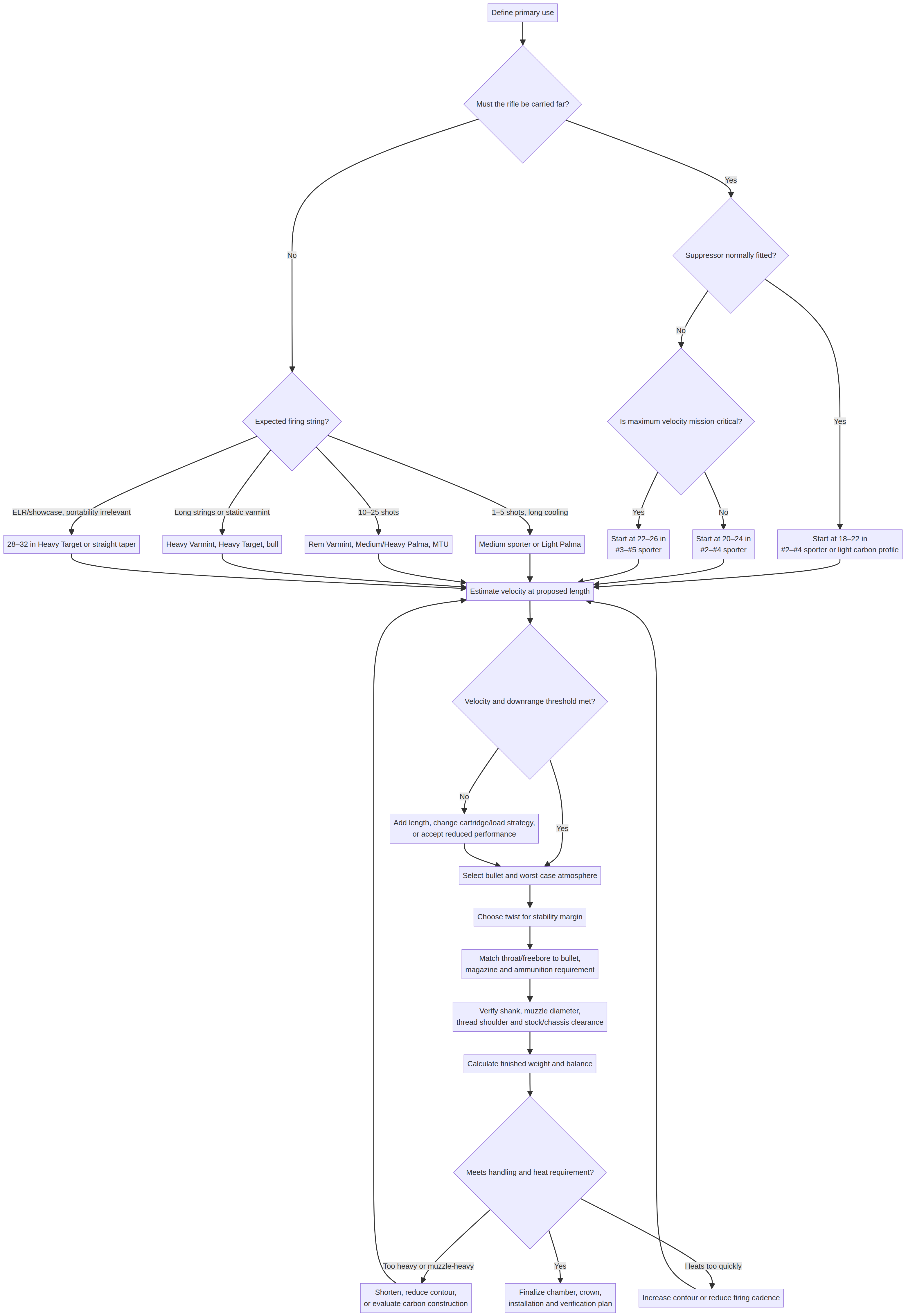
Barrel selection flowchart — start at "Define primary use" and follow the decision tree to a starting specification.
How the Rifle System Advisor Uses This Research
Cartridge-specific fps/inch averages from Hodgdon's published cut-down tests and Ballistics By The Inch data. Overbore cartridges use higher fps/inch values per Hodgdon's guidance (~35 fps/in vs. ~25 fps/in for standard cartridges). Results are shown as a range with an uncertainty band — not a single number — because the relationship is nonlinear and load-specific.
Approximate unchambered steel blank weights from Krieger Barrels published specifications, interpolated for length. Actual finished weight varies with bore diameter, chamber volume, tenon, final cut length, muzzle threads, fluting, and manufacturer geometry.
Based on Proof Research published specifications claiming up to 64% weight reduction. Treated as Proof-specific, not universal to all carbon barrels.
Estimated at 12% based on published comparisons. Actual reduction depends on flute depth, count, and length.
Qualitative classifications based on contour mass relative to shot cadence, per Krieger and Bartlein published guidance.
Based on the 1.5×–2× barrel weight rule used by custom rifle builders to estimate the stock/action weight needed to keep the center of gravity near the trigger guard. Action weight assumed at 2.5 lbs; optic at 1.5 lbs.
Derived from the use-case table above, which is itself a synthesis of the controlled velocity tests, published contour weights, and barrel-maker observations cited throughout this document.